

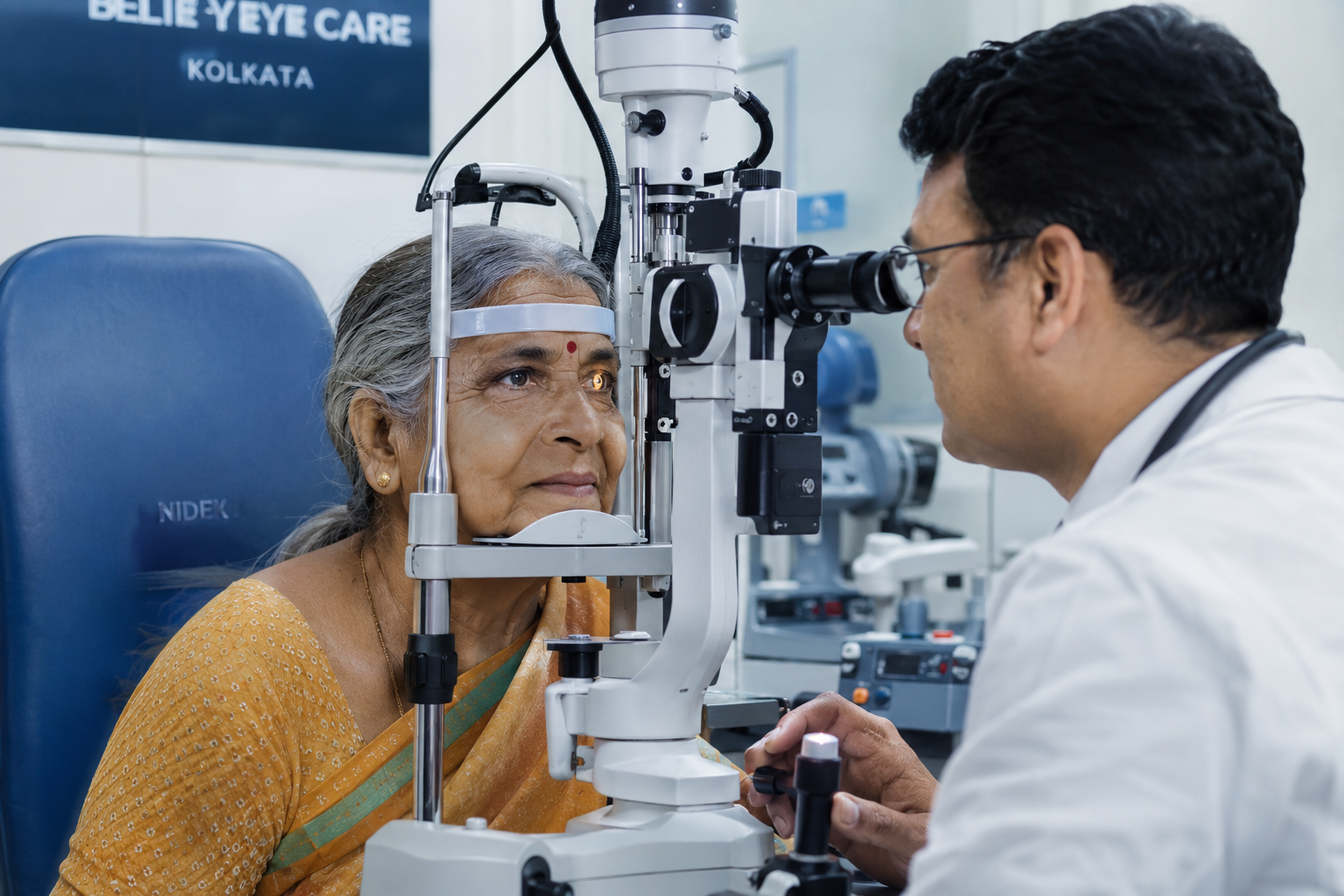
Picture this: you are trying to read a street sign on Park Street, and it looks like someone’s smudged Vaseline across your glasses. You blink. You wipe your eyes. Nothing changes. Colours feel duller, headlights at night turn into starbursts, and reading the newspaper has quietly become a squinting match you keep losing.
If this sounds familiar, you’re not “just getting old.” You might be dealing with a cataract, and the good news is, it’s one of the most treatable conditions in all of medicine. This blog is your friendly, no-jargon guide to cataract treatment in Kolkata, why the city has become a genuine hub for it, and what actually happens when you decide to get your vision back.
Table of Contents
Wait, What Exactly Is a Cataract?
Think of the lens inside your eye like a camera lens, clear, flexible, and built to let light pass through cleanly. Over time, usually after your 50s, though it can happen earlier, that lens can turn cloudy, a bit like a window fogging up on a humid Kolkata monsoon morning. That fog is a cataract.
It doesn’t hurt. It doesn’t happen overnight. It just creeps in a little blur here, a little glare there, until one day you realise you have been living with a permanently foggy window and calling it normal.
Why Are So Many People Searching for Cataract Treatment in Kolkata?
Kolkata isn’t just the City of Joy; it’s quietly become one of the most trusted destinations in eastern India for eye care. A few reasons why:
- Experienced ophthalmologists who’ve spent decades refining lens replacement techniques
- Advanced technology including femtosecond laser-assisted surgery and premium intraocular lenses (IOLs)
- Affordability compared to many metro cities, without compromising on quality
- Accessibility: whether you’re from Salt Lake, Howrah, Behala, or coming in from Siliguri or even Bangladesh for treatment, the city’s hospitals are used to handling patients from all over the region
For thousands of families, cataract treatment in Kolkata has become less of a medical decision and more of a “why did I wait so long” decision.
The Surgery That Takes Less Time Than Your Lunch Break
Here’s the part that surprises most people: cataract surgery in Kolkata today is nothing like the surgery your grandparents may have had.
Modern cataract surgery typically uses a technique called phacoemulsification, a fancy word for a simple idea. A tiny probe uses ultrasound waves to gently break up the cloudy lens, which is then removed through a micro-incision so small it often doesn’t even need stitches. A new, clear artificial lens (the IOL) is then placed exactly where your natural lens used to be.
The whole thing?
- Usually 15–20 minutes per eye
- Performed under local anaesthesia
- Walk-in, walk-out; most patients go home the same day
- Noticeable improvement in vision within 24 to 48 hours
No hospital stay. No general anaesthesia. No long, dramatic recovery montage. Just a quick procedure and a surprisingly fast return to seeing the world in full HD again.
Choosing the Right Lens: More Choices Than You Would Expect
One thing that catches people off guard is realising that cataract surgery isn’t just about removing the cloudiness; it’s also an opportunity to correct your overall vision. Depending on your eyes and lifestyle, your doctor may discuss:
- Monofocal lenses – the standard option, great for distance vision, may still need reading glasses
- Multifocal lenses – designed to reduce dependency on glasses for both near and far vision
- Toric lenses – ideal if you also have astigmatism
- Extended depth of focus (EDOF) lenses – a newer option balancing near and distance clarity
This is exactly why choosing the right eye care centre matters; the right consultation helps you pick a lens suited to your actual life, not a one-size-fits-all fix.
Signs You Shouldn’t Ignore
Not sure if it’s time to get checked? Watch out for:
- Vision that seems “cloudy,” “foggy,” or like looking through a dusty windshield
- Increasing sensitivity to bright light or headlights while driving at night
- Colours appearing faded or yellowish
- Frequent changes in your glasses prescription that don’t seem to help
- Difficulty reading, watching TV, or recognising faces from a distance
If two or more of these sound familiar, it’s worth booking a simple eye check-up. Cataracts don’t go away on their own, but they are entirely fixable.
Busting the Big Myths
“Cataract surgery is only for very old people.” Not true. While it’s common after 60, cataracts can develop due to diabetes, prolonged steroid use, eye injuries, or even genetics, sometimes much earlier.
“You have to wait until the cataract is ‘fully ripe.'” This is outdated thinking. Modern guidance suggests treating it once it starts affecting your daily life, not waiting until you’re nearly blind in that eye.
“Recovery takes weeks.” Most people are back to reading, watching TV, and doing light daily activities within a day or two, with full stabilisation over a few weeks.
Making Your Decision: What to Actually Look For
When researching cataract treatment in Kolkata, it helps to prioritise:
- A qualified, experienced ophthalmic surgeon with a strong surgical track record
- A centre offering modern technology (phaco or femto-laser assisted surgery)
- Transparent pricing with no hidden costs
- A clear post-op care plan, including follow-up visits and eye drop schedules
- Genuine patient reviews and testimonials, not just glossy brochures
A good clinic won’t rush you. They will explain your specific cataract, walk you through lens options, and answer every “silly” question you have; spoiler: none of them is silly.
Your Vision Is Worth It
There’s something quietly emotional about regaining clear vision, seeing your grandchild’s face clearly for the first time in years, reading without squinting, driving at night without every headlight turning into a blinding star. Cataract surgery in Kolkata isn’t just a medical procedure; for many, it’s the moment the world gets its colours back.
If blurry vision has been your quiet, unspoken normal for too long, Kolkata’s growing ecosystem of skilled eye surgeons and modern eye hospitals makes it easier than ever to address it safely, affordably, and quickly.
Don’t let cloudy vision write the next chapter of your life.
Talk to a qualified ophthalmologist (link), ask about your options, and take that first clear step back toward sharp, vibrant sight.
FAQ:
- Does cataract surgery hurt?
Honestly, this is the first question almost everyone asks, and the honest answer is: no, not really. Your eye is numbed with local anaesthesia before the procedure so that you won’t feel pain; at most, a little pressure or a strange awareness that something’s happening. Most people say the scariest part was the idea of the surgery, not the surgery itself.
- How long before I can go back to my normal life?
Much sooner than most people expect. Many patients notice clearer vision within a day or two, and simple activities like watching TV, reading, or walking around the house can usually resume almost immediately. Your doctor will likely ask you to avoid heavy lifting, swimming, or rubbing your eye for a couple of weeks, just to let things heal properly. Think of it less as “recovery” and more as a short, careful settling-in period. - Will I still need glasses after the surgery?
It depends on the lens you choose. If you go with a standard monofocal lens, you may still need glasses for reading or fine print. But newer options like multifocal or EDOF lenses are designed to reduce your dependency on glasses for both near and far vision. This is exactly why a proper conversation with your surgeon beforehand matters; it’s not one-size-fits-all; it’s about what fits your eyes and your lifestyle. - What if I only have a cataract in one eye, do I need surgery on both?
Not necessarily, and definitely not at the same time. Many people start with just the eye that’s bothering them more. If cataracts eventually form in the other eye too, which is common as we age, that one can be treated separately, on its own timeline. No rule says both eyes must be done together; your doctor will guide you based on how each eye is actually doing.


